Given the large costs of crime to society, there is substantial policy interest in identifying effective crime-prevention strategies. Many studies have focused on the effects of increasing the size of the police force and on the effects of tougher sa...
This paper asks whether improving the quality of public schools can be an effective long-run crime-prevention strategy in the U.S. Specifically, we examine the effect of school quality improvements early in children's lives on the likelihood that the...
Applications for federal and state financial aid for college are a leading indicator of how many students will enroll in and complete a college degree. The Free Application for Federal Student Aid (FAFSA) and the Tuition Incentive Program (TIP), a Mi...
School finance reforms caused some of the most dramatic increases in intergovernmental aid from states to local governments in U.S. history. We examine whether teacher unions affected the fraction of reforminduced state aid that passed through to loc...
The controversial No Child Left Behind Act (NCLB) brought test-based school accountability to scale across the United States. This study draws together results from multiple data sources to identify how the new accountability systems developed in res...
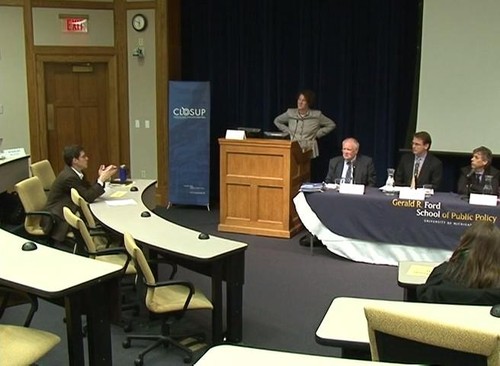
Thomas H. Howlett, Andy Jacob, Christopher Mullin, Richard Vedder and moderator Susan Dynarski discuss for-profit colleges in the latest in the Education Policy Initiative Seminar Series at CLOSUP. November, 2010.